




18+ GambleAware.org | Please gamble responsibly
Boxing is one of the most watched professional sports on the planet, with attractive heavyweight clashes or highly technical, fast-paced lightweight or featherweight battles. Boxing history shows the sport emerging from humble beginnings to box office show-stopper.
The sport hasn’t always enjoyed such a glamorous existence, though, as we’ll explore in more detail in our deep dive into the background of boxing.
Where Did Boxing Originate?
Although the exact origin of boxing is unclear, there have been some inferences that boxing existed as early as 3000 BC. That’s thanks to data from a Sumerian carving and artefacts from Mesopotamian regions like Babylonia and Assyria from 2000 BC.
The Ancient Greeks would formalise boxing as a sport at the 23rd Olympiad, although it was still very much an amateur pursuit at this stage.
In Ancient Rome, boxing rapidly became a popular spectator sport. Roman boxers were required to wear a cestus to ‘box’. A cestus was a metal-studded leather glove which competitors wore to strike, maim and, worse still, kill their opponents.
In many ways, boxing took on an almost gladiatorial level. However, the fall of the Roman Empire brought about a decline in boxing’s popularity. It wasn’t until several centuries later that it would be revived.
Why is it Called Boxing?
In ancient times, the sport of boxing was known as ‘pugilism’. This term comes from the phrase ‘pugil’, which described ‘a boxer’. The word pugil evolved from the Latin word ‘fungus’, used to describe a fist.
The modern-day nickname for boxing is ‘sweet science’. This tag was given to the sport when it became a professional pursuit, underlining the tactical and strategic elements needed to succeed in contemporary boxing.
Where and When was the First Boxing Fight in the UK?
The boxing chronicle known as Pugilistica says the first formal newspaper story surrounding bare-knuckle boxing fights dates back to 1681. The Protestant Mercury mentioned a fight between the Duke of Albemarle’s footman and a local butcher.
The article stated that the butcher won the bout and was described as “the best at that exercise in England”. Whether this statement was true remains to be seen, but there’s no formal record of who this butcher was.
Less than 50 years later, it’s clear bare-knuckle boxing had shot to prominence nationwide. In 1719, a man named James Figg was crowned English bare-knuckle champion. He would retain this title until his ‘retirement’ in 1730.
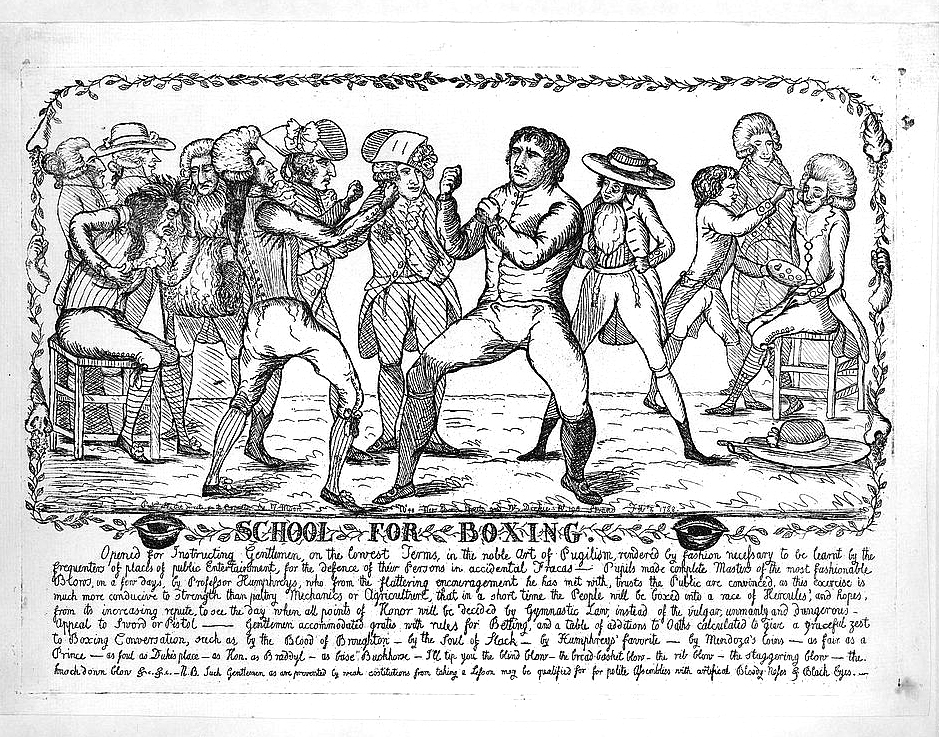
In 1743, a bare-knuckle champion, John Broughton, succeeded in establishing a standard framework of boxing rules, explaining how fighters can eliminate their opponents. Known as ‘Broughton’s Rules’, this framework remained in place until 1838 following the creation of the Original London Prize Ring Rules, which were the predecessor to the popular Queensberry Rules.
When Were the Queensberry Rules Put in Place?
The Queensberry Rules of boxing were formalised in 1867, and these rules are a major part of boxing history as they’ve guided the sport’s modern-day era. The Queensberry Rules and code of conduct were penned by John Graham Chambers, who was part of the British Amateur Athletic Club at the time.
The new code for boxing was sponsored by the ninth Marquess of Queensberry, John Sholto Douglas, hence the name of the regulatory framework.
Although the Queensberry Rules were established in 1867, the final sanctioned bare-knuckle boxing match took place in 1889 between John L. Sullivan and Jake Kilrain. Three years later, Sullivan would fight under Queensberry Rules against James J. Corbett, losing his world heavyweight title in September 1892.
The basics of the Queensberry Rules
- No hugging or wrestling permitted.
- Boxing match should be in a 24ft ring – or as close to this as possible.
- Three-minute rounds with 60-second intervals.
- If either boxer falls, they must stand up unaided within ten seconds.
- All boxing gloves to be reasonably sized and of premium quality.
- Trainers or boots with springs prohibited.

Boxing in the Early 20th Century
Amateur boxing thrived in the early 20th century. The Amateur Boxing Association (ABA) was established in the UK, and the Amateur Athletic Union (AAU) was founded in the United States and began staging bouts under Queensberry Rules. Amateur boxing soon became a popular pursuit across Europe and beyond, resulting in its inclusion in the Olympic Games program from 1904.
As for professional boxing, this, too, showed signs of becoming big business in the early 1900s. George “Tex” Rickard was the go-to boxing promoter in the early 20th century. In 1906, Rickard staged a world lightweight championship bout in the Nevada mining town of Goldfield in a bid to shine a spotlight on the area. The commercial success of this fight between Joe Gans and Oscar Nelson lit the blue touch paper for what we know now as “prize fighting”.
Rickard’s relationship with world heavyweight champion Jack Dempsey was undoubtedly his biggest success. No less than five of his world heavyweight title defences between 1919 and 1926 grossed over $1 million at the box office.
The Great Depression was ill-timed for professional boxing. This, coupled with Dempsey’s retirement, saw revenues decline. That was until the rise of boxing icon Joe Louis, who raked in over $5 million in his career purse. Post-World War II, professional boxing had successfully established itself in popular culture. It gradually secured more airtime due to its production costs, which were comparatively cheaper than other mainstream sports.
There are few professional sports where competitors need to be in better physical condition than boxers, which is one of the main reasons sports fans are attracted to it. Aside from gruelling sports like Rugby League and Formula 1 with all of the G-Force training needed, boxing stands alone as a physical test of skill and endurance.
The Current State of Boxing
As important as the history about boxing is, the sport’s present and future are equally important. It’s fair to say the sport is in a very strong place right now.
Many boxing fans and pundits say that boxing is only as strong as its heavyweight division – and this division has been on the lips of many punters in the last decade. The rise of ‘The Gypsy King’, Tyson Fury, has enchanted the boxing world.
His shock 2015 win over Wladimir Klitschko in Germany catapulted him into another dimension. He battled back from mental health issues to prevail in a captivating trilogy with Deontay Wilder. Fight fans worldwide remain desperate for him to lock horns with Ukrainian fighter Oleksandr Usyk in a bout to become the world’s undisputed heavyweight champion.
One of the fastest-growing trends in boxing today is professional women’s boxing. The British Board of Boxing Control (BBBC) did not issue licences to female boxers until Jane Couch in the late 1990s. By 2012, the summer Olympic Games had introduced women’s boxing to its sporting roster.
British boxer Nicola Adams represented the UK at the 2012 Olympics, winning gold at flyweight. Adams defended her title at the 2016 Rio Olympics before becoming professional in 2017. Natasha Jonas also turned professional in the same year, and the Brit has been a two-weight world champion. Ireland has also been captivated by the success of Katie Taylor, who is currently a two-weight world champion herself.
In 2022, two professional female boxers headlined a boxing event at a major UK venue for the first time. London’s O2 Arena staged the clash between middleweight titans Savannah Marshall and American Claressa Shields.
Aside from the rude health of women’s professional boxing, there has also been a recent surge in interest surrounding ‘YouTube boxing’. Many social media personalities have attempted to make waves in professional boxing. The likes of Joe Weller, KSI and the Paul brothers, Jake and Logan, have seen huge fights promoted and attracting unprecedented attention despite their novice status in the boxing world.
KSI and Logan Paul have had two keenly contested fights in Manchester and Los Angeles. At the Los Angeles rematch, eyebrows were raised when professional boxers Billy Joe Saunders and Devin Haney were placed on the undercard of the headline event involving two YouTube boxers. Many professional boxers have gone public in their criticism of YouTuber boxing, with traditionalists insisting that it devalues the skill level of the sport.
Nevertheless, professional boxers have sought to lock horns with these YouTube personalities in the ring. Tyson Fury’s brother, Tommy, fought Jake Paul in Saudi Arabia and only won by a points decision.
Exhibition fights are still hugely popular. Tyson Fury Vs Francis Ngannou, who is more familiar to UFC betting experts, is the latest in a growing line of popular bouts in the boxing betting markets.
If you’re keen on betting on the latest fight cards, be sure to bet responsibly. Take a look at our Safer Gambling Portal to learn more about limiting deposits or opting out.
18+ | begambleaware.org | Please Gamble Responsibly