





18+ GambleAware.org | Please gamble responsibly
Casual followers of combat sports often use the terms UFC and MMA interchangeably as synonyms, but true combat sports enthusiasts, like us here at Parimatch, know the difference between the two.
We’d like to clear up the confusion, once and for all, on the difference between UFC and MMA.
Are UFC and MMA the same?
UFC and MMA are not the same. Mixed martial arts (MMA) is the sport, and the Ultimate Fighting Championship (UFC) is an organisation which puts together MMA fights. In a nutshell, all UFC events consist of MMA, but not all MMA is UFC. The reason why MMA and UFC are often confused is due to the huge popularity of the UFC.
In fact, with data taken from Google Trends, we can see, slowly but surely, that UFC has overtaken MMA in Google Search quite drastically. It’s easy to see why the two are confused.
Take a look:
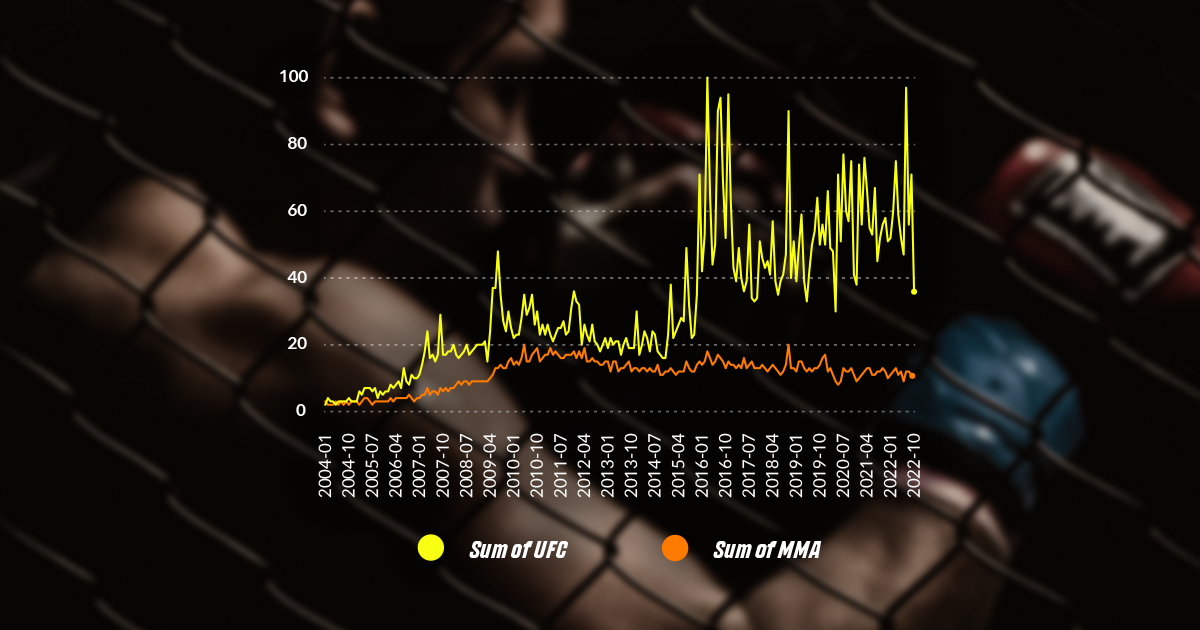
Since 2004, we can see a steady increase in the use of the word UFC in the UK. The UK first got a taste for the UFC when the first British Fight Night was held at Royal Albert Hall in London back in 2002. It later returned to the UK when Manchester hosted UFC 70 in 2007. From then onwards, we can see a sudden boom in people searching for the UFC in the UK from 2016. What really cemented the UFC as a household name was UFC 196 and 202, where the most popular mixed martial artist in the UK & Ireland, Conor McGregor, fought Nate Diaz twice. Ever since, the UK has caught UFC fever.
UFC fights are now a Goliath in the MMA world, with the organisation reportedly worth between $9-10 billion. It hosts some of the biggest fights with some of the biggest names, like Conor McGregor, Charles Oliveira, Petr Yan, Sean O’Malley and many more.
UFC matches are always exciting to watch with underdogs and favourites. It’s a thrill to see who will go all the way to win the bout.
Are the rules for MMA and UFC Different?
Nowadays, practically all MMA organisations have adopted the Unified Rules of MMA, but that’s not always the case, and there are many differences between organisations and even countries. For instance, in Asian MMA competitions, like in the ONE championship, competitors are permitted to kick an opponent in the head even if they are on the ground. Recently, MMA fighter Michael Pereira was disqualified for kneeing Diego Sanchez when he was down.
MMA regulations outside of the United Fighting Championships (UFC) may differ. The UFC sets its own rules and fouls (the UFC are very tough on this, sometimes going beyond the Unified Rules of MMA), weight classes, and what kind of cage or ring they use. The UFC uses an 8-sided ring, the Octagon. The UFC also regulates attire and sportswear: no shoes or any foot padding allowed, no trousers to be worn, and approved mouthguards and gloves only.
How did MMA and UFC start?
MMA as a sport has a long history, stretching across time and cultures, but modern MMA really came into fruition in the 20th century, along with the UFC in the latter half.
MMA History
Mixed Martial Arts has its roots in Brazil, originally called “Vale Tudo”, Portuguese for “Anything Goes”. An unarmed, full-contact sport with little to no rules, the sport first became popular in Brazil before it grew to worldwide popularity and transformed into the sport we know today, MMA. Since the 2000s, Vale Tudo has fallen from favour due to its lack of regulations and bloody nature, with fighters much preferring to follow the unified rules of MMA.
Originally MMA events were a single-night, single-round competition comprising top athletes skilled in specific martial arts disciplines, including karate, jiu-jitsu, boxing, kickboxing, grappling, wrestling, sumo, and other combat sports. The goal was to find the “ultimate” martial art, but this didn’t always work out, as is apparent in the much-debated match between Muhammed Ali and Antonio Inoki, pitting a professional boxer and wrestler against each other. Later, the practice of combining different fighting styles from different martial arts became popular.
UFC History
The UFC came about in 1993 in Las Vegas founded by Art Davie and Rorion Gracie, a skilled Brazilian mixed martial artist who fought in Vale Tudo fights. In the beginning of UFC competitions, there were minimal rules and no weight classes, the classic slogan being “There are no rules”. But from the early 2000s onwards, the UFC have significantly tightened up on rules, being one of the MMA organisations to have some of the strictest rules out there.
Recent Trends in MMA and the Future of MMA
The sport of MMA is constantly evolving.
In the early days of MMA, fighters who specialised in a particular martial art were pitted against each other. Nowadays, fighters are much more well-rounded, and a distinct MMA style has emerged. Fighters are now trained in various disciplines and this combination of techniques has made modern fighters highly versatile. In other words, MMA has become a true martial art in its own right, with its own unique identity.
Another breakthrough in the MMA world is the rise and popularity of all women cards. Claressa Shields and Savannah Marshall (a British boxer following the trend of moving over to MMA fights as well) made history in headlining the first all women Fight Night in MMA.
Now that you know the fundamental difference between UFC and MMA, if you’re interested to learn more, then keep up to date with our blog, and if you want to see the latest odds for your favourite fighter, then check out our MMA/UFC Betting page.
Join Parimatch to have access to all our sports betting odds and online casino games.
18+ | Please Gamble Responsibly